How to Safely Move Aluminum Profiles: Storage, Forklift Handling and Transport Best Practices
Aluminum profiles are light compared with steel, but that does not make them easy to move safely. Their length, shape, surface finish, and sensitivity to bending or scratching create handling risks that standard pallets and improvised supports do not solve well.
This guide explains how to move aluminum profiles safely through storage, forklift handling, crane lifting, and road transport, and what buyers should define before ordering custom racks, stillages, or transport frames.
Profile length shifts the center of gravity and increases the chance of bending, instability, and forklift overload.
Aluminum profiles can lose value quickly if they are dragged, stacked poorly, or contact hard support points.
Support spacing, fork position, and rack geometry all affect whether profiles stay straight and stable.
Purpose-built racks and stillages usually outperform generic pallets when profile lengths or finish requirements are demanding.
Why moving aluminum profiles safely is not a simple pallet problem
Long aluminum profiles behave differently from compact palletized goods. Even when the total weight is modest, the load can still become difficult to handle because the profile length increases the load center, changes the way forces act through the forklift, and creates a higher risk of deflection or surface damage.
OSHA’s forklift guidance makes the key principle clear: truck capacity depends on the stated load center, and oversized or irregular loads can reduce practical safe capacity well below the number on the truck data plate. That matters immediately when profiles are long, off-center, or not fully supported.
Main handling risks when moving aluminum profiles
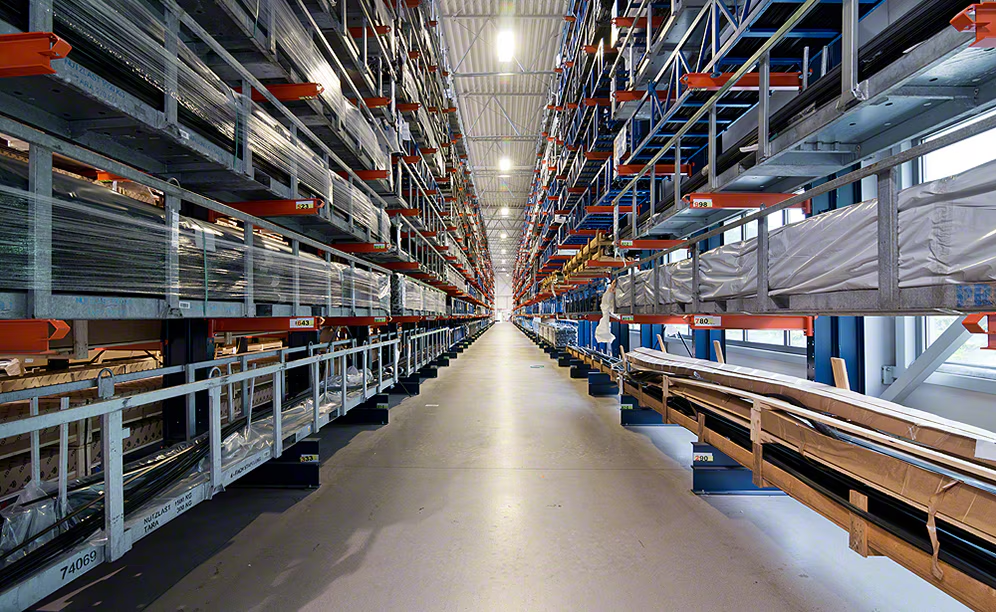
Aluminum profiles can fail operationally long before they fail structurally. The biggest problems are often bending, scratching, unstable loading, edge damage, and poor load restraint during transport.
- Long load geometry moves the center of gravity farther from the forks or lifting points.
- Insufficient support spacing can cause local distortion or visible deflection.
- Surface sensitivity means dragging, metal-to-metal contact, or bad stacking can damage finished profiles.
- Mixed bundle instability makes forklift handling unpredictable if lengths or sections vary.
- Inadequate restraint allows profiles to shift in transport or while being set down.
Hydro’s published handling guidance for aluminum products reinforces the same practical idea: avoid scraping against hard surfaces, avoid dragging, and use soft lifting methods where distortion or surface damage is a concern.
Forklift handling: load center, fork spacing, and stability
Forklifts are commonly rated around a standard load center, often 24 inches. Once the load becomes longer, off-center, or irregular, the effective safe capacity can drop. OSHA’s eTool explains that the farther the center of gravity moves forward, the more the lifting capacity is reduced and the greater the tip risk becomes.
For long aluminum profiles, that means the operator and the equipment designer both need to focus on three things:
- keeping the profile bundle as close to the carriage as possible;
- spreading fork support as far as the load safely permits;
- using a rack, frame, or stillage that keeps the bundle centered and stable.
| Handling factor | Why it matters | Practical response |
|---|---|---|
| Load center | Long profiles shift weight farther from the fork face | Use racks or stillages that keep the bundle compact and close to the carriage |
| Fork spacing | Narrow support increases instability and profile deflection | Set forks as wide as the frame or load permits |
| Bundle restraint | Loose profiles can roll, spread, or shift under acceleration | Use separation, side restraint, and positive locating features |
| Travel position | High carried loads reduce truck stability | Carry low, move slowly, and avoid abrupt braking or turning |
Storage and support: prevent sagging, scratching, and mix-ups
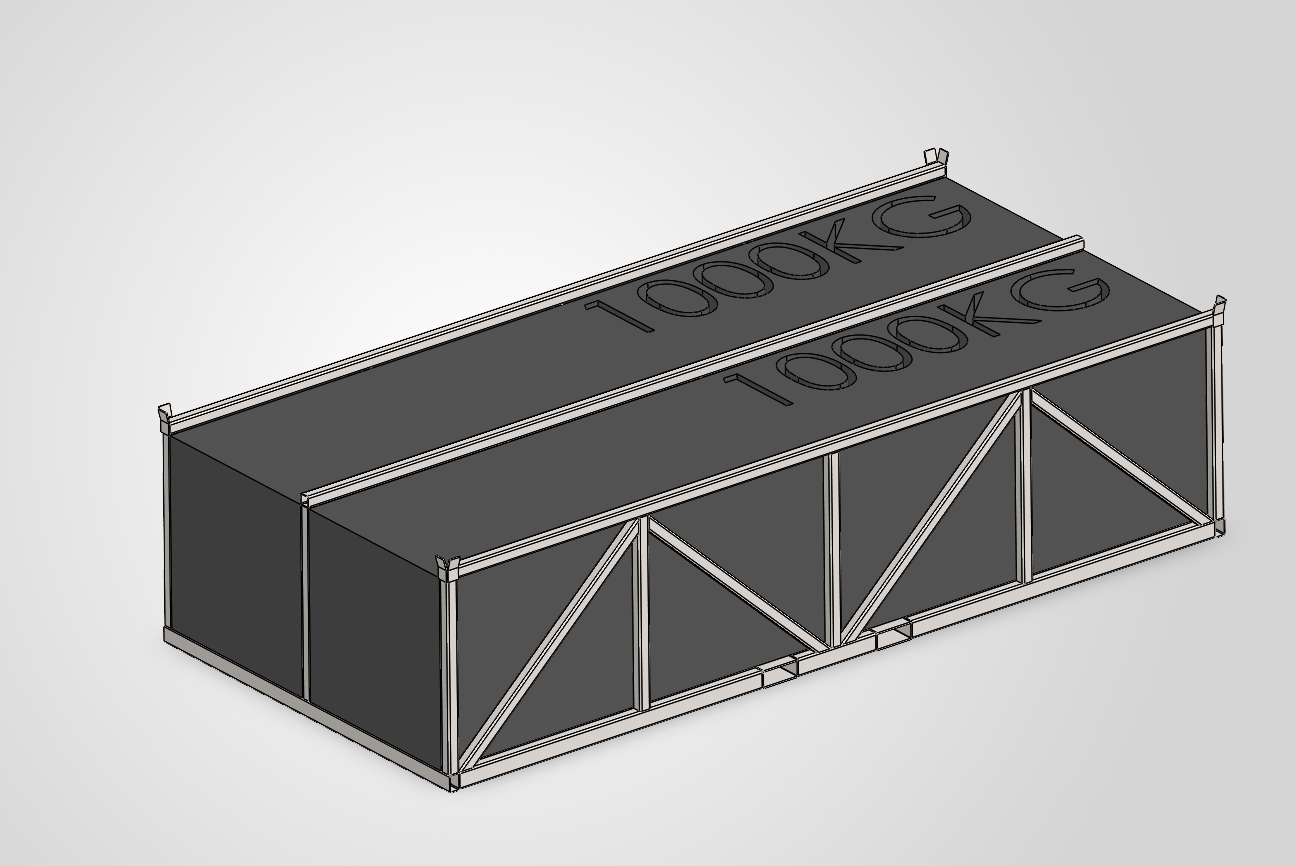
Profiles should never be stored as an afterthought. Once lengths increase, a poor storage method quickly becomes a handling problem as well. The right rack design keeps the load straight, separated, identifiable, and accessible without repeated manual rehandling.
Good storage practice for aluminum profiles
- support profiles across enough points to prevent excessive sagging;
- avoid direct contact with dirty floors, standing water, or abrasive surfaces;
- keep finished or visible surfaces protected from rubbing and impact;
- separate lengths, alloys, or customer orders to reduce handling mistakes;
- make sure operators can engage the rack safely without guessing fork position.
Where profile value is high or finish quality is critical, purpose-built storage racks are usually cheaper than repeated product damage, rework, or transport claims.
With long aluminum profiles, the storage system is part of the handling system. If storage is weak, movement will be weak as well.
Transport: keep aluminum profiles restrained and protected
Road transport adds vibration, acceleration, braking, and weather exposure. A bundle that looks stable in the yard can still move enough in transport to damage edges, deform longer members, or mark visible surfaces.
That is why a transport rack or stillage should do more than carry weight. It should also control location, prevent rolling or lateral shift, and protect surfaces at the exact points where contact forces occur.
- Use positive side restraint rather than relying only on straps to control shape.
- Prevent metal-to-metal abrasion at contact zones.
- Match support spacing to profile length and stiffness.
- Design for stacking only if the rack and product can safely tolerate that condition.
- Consider weather and corrosion exposure if racks remain outdoors between cycles.
When a custom rack, stillage, or transport frame is the better solution
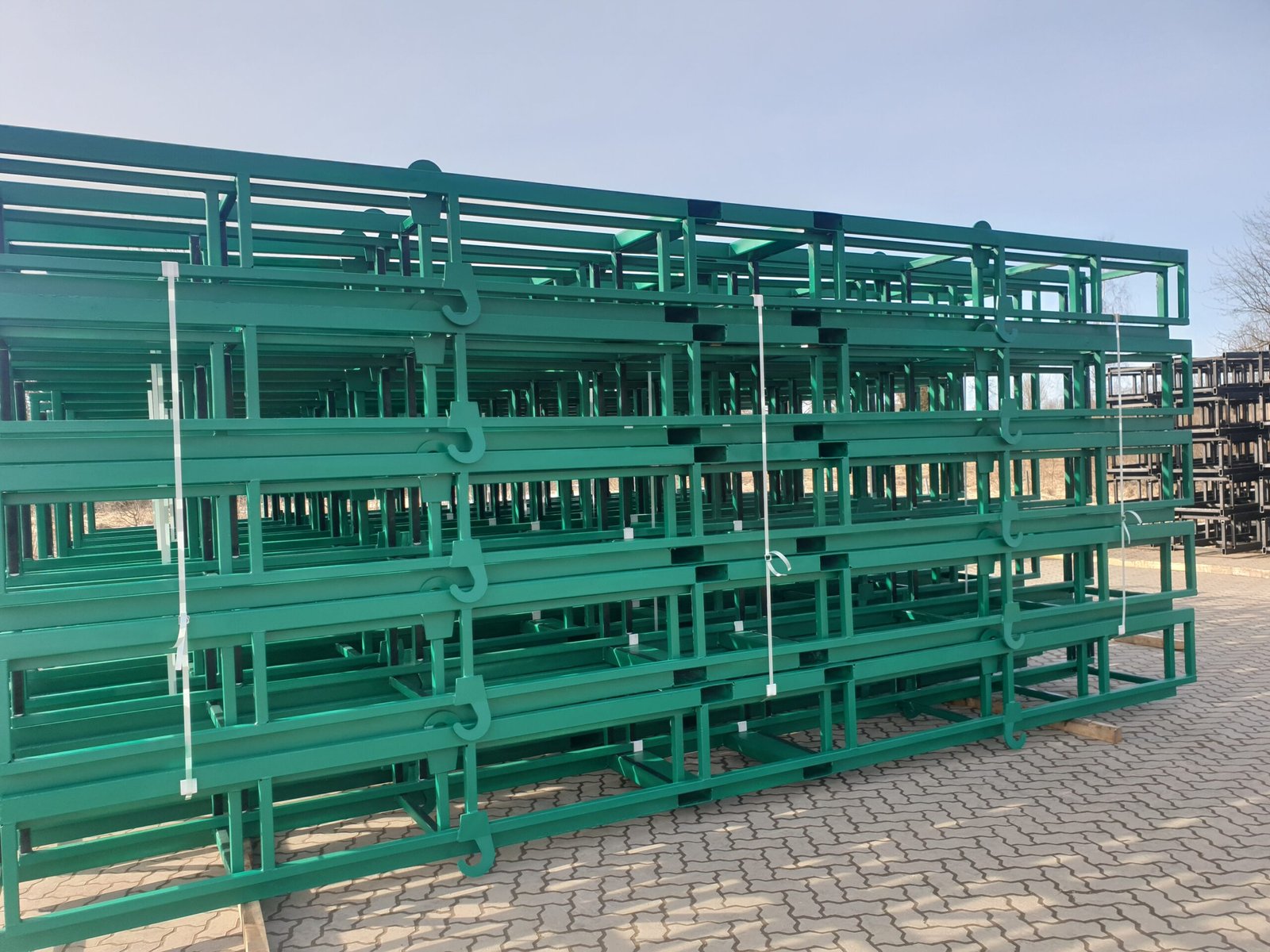
If aluminum profiles are moved repeatedly, stored for long periods, or shipped between sites, a custom handling unit often makes more sense than improvised timber packs or generic pallets.
The strongest reasons to move toward a custom solution are usually:
- profile lengths that are awkward for standard pallets;
- surface-finish sensitivity;
- mixed bundles that need separation or order control;
- stacking or return-logistics requirements;
- the need to combine storage, forklift handling, and transport in one reusable unit.
For the steel structure itself, the same engineering logic covered in the existing GorillaBasket SWL guides still applies. If the rack or frame is going to be lifted, stacked, or heavily loaded, its Safe Working Load should be clearly defined and, where needed, verified.
Planning a safer way to move aluminum profiles?
Share the profile lengths, bundle weights, handling method, stack requirements, and finish sensitivity. That is enough to evaluate whether a cantilever rack, stillage, transport frame, or custom long-load solution is the right fit.
Accepted formats: DWG, DXF, STEP, PDF drawings, or simple sketches.
What buyers should define before ordering handling equipment for aluminum profiles
- profile length range and maximum bundle weight;
- whether handling is by forklift, crane, or both;
- required support spacing and any known deflection limits;
- surface-finish sensitivity and contact protection needs;
- indoor or outdoor storage conditions;
- whether units need stacking, nesting, or return transport capability.
Clear inputs at the start produce a safer, cleaner, and more economical handling solution. Poor inputs usually lead to damage risk, redesign, or unnecessary overbuilding.
Frequently asked questions about moving aluminum profiles safely
Why are long aluminum profiles difficult to move safely?
Can a standard forklift handle aluminum profiles safely?
How should aluminum profiles be stored to avoid damage?
When is a custom stillage or transport rack worth it?
Should the rack or frame itself have a Safe Working Load?
Conclusion
Moving aluminum profiles safely depends on more than choosing a truck or adding a few timber supports. The safe solution comes from understanding profile length, support spacing, surface sensitivity, forklift load center, and transport restraint as one system.
Where movement is frequent or the product is high value, a purpose-built rack or stillage is usually the safer and more economical option.
For related reading, continue with Safe Working Load, SWL Testing for Custom Steel Fabrications, and Steel Pallets vs Wooden Pallets.
Need a custom aluminum profile handling solution?
Send the lengths, bundle weights, dimensions, and handling method, and GorillaBasket can evaluate a rack, stillage, or transport frame built around the actual profile load.