What Products Use Gitterboxes and Stillages in Scandinavia? Finland, Sweden, Norway and Denmark
Across Scandinavia, reusable steel gitterboxes and stillages are used wherever product protection, repeat handling, and return logistics matter more than one-way packaging cost. The exact product mix changes by country, but the underlying logic stays the same: long-term industrial handling systems need reusable structures that survive real operations.
This guide explains what kinds of products typically use gitterboxes and stillages in Finland, Sweden, Norway, and Denmark, and why these steel handling units remain standard equipment in many Nordic supply chains.
Nordic industrial supply chains often justify reusable steel packaging because products move repeatedly between plants, suppliers, and distribution hubs.
Machined parts, fabricated components, profile-based products, and heavy industrial items are common candidates.
Cold weather, outdoor yards, and long transport distances make durable reusable units more attractive than one-way packaging.
Many Nordic manufacturers handle non-standard products that need defined support points, stacking logic, and traceable pack patterns.
Why gitterboxes and stillages remain common in Scandinavia
Scandinavian industry is not one uniform market, but Finland, Sweden, Norway, and Denmark share several conditions that make reusable steel handling units attractive. Products often move over long distances. Many supply chains run in closed or semi-closed return loops. Outdoor storage is common. And a large share of handled goods are heavy, awkward, long, valuable, or repeatedly moved between the same production sites.
That combination creates a clear case for gitterboxes and stillages. Compared with disposable packaging, they offer repeatable handling geometry, stronger protection, better stackability, and more predictable return logistics.
What kinds of products commonly use gitterboxes and stillages
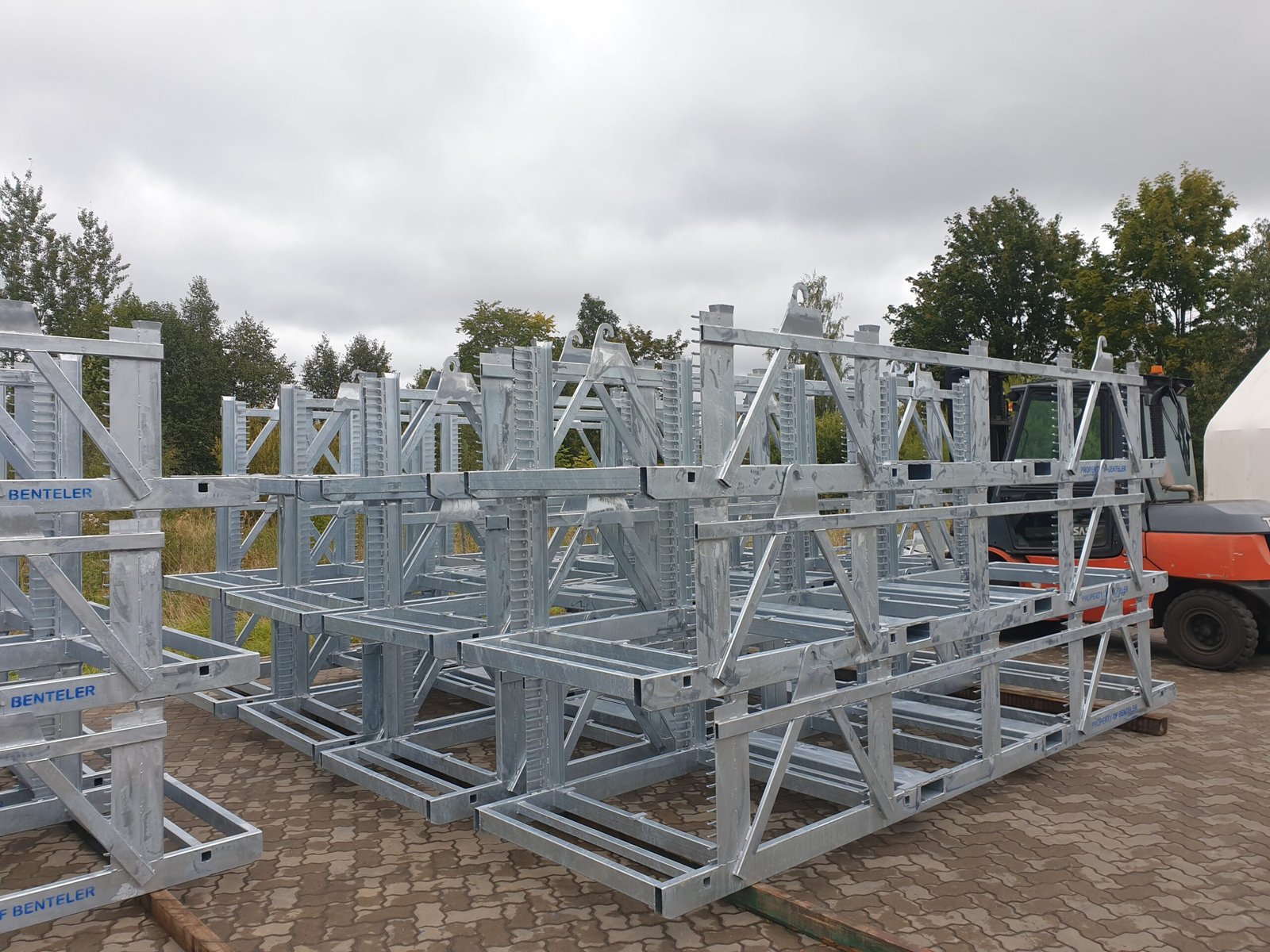
The products most often packed in reusable steel units have one or more of the following characteristics: they are heavy, they have an unstable shape, they need a repeatable pack pattern, they cannot tolerate surface damage, or they move repeatedly between fixed sites. In practice, this usually means:
- machined metal parts and castings;
- fabricated steel components and welded assemblies;
- aluminum profiles, frames, and long parts;
- automotive and off-highway subcomponents;
- industrial service parts and aftermarket components;
- construction-related metal items requiring stacking and safe forklift access.
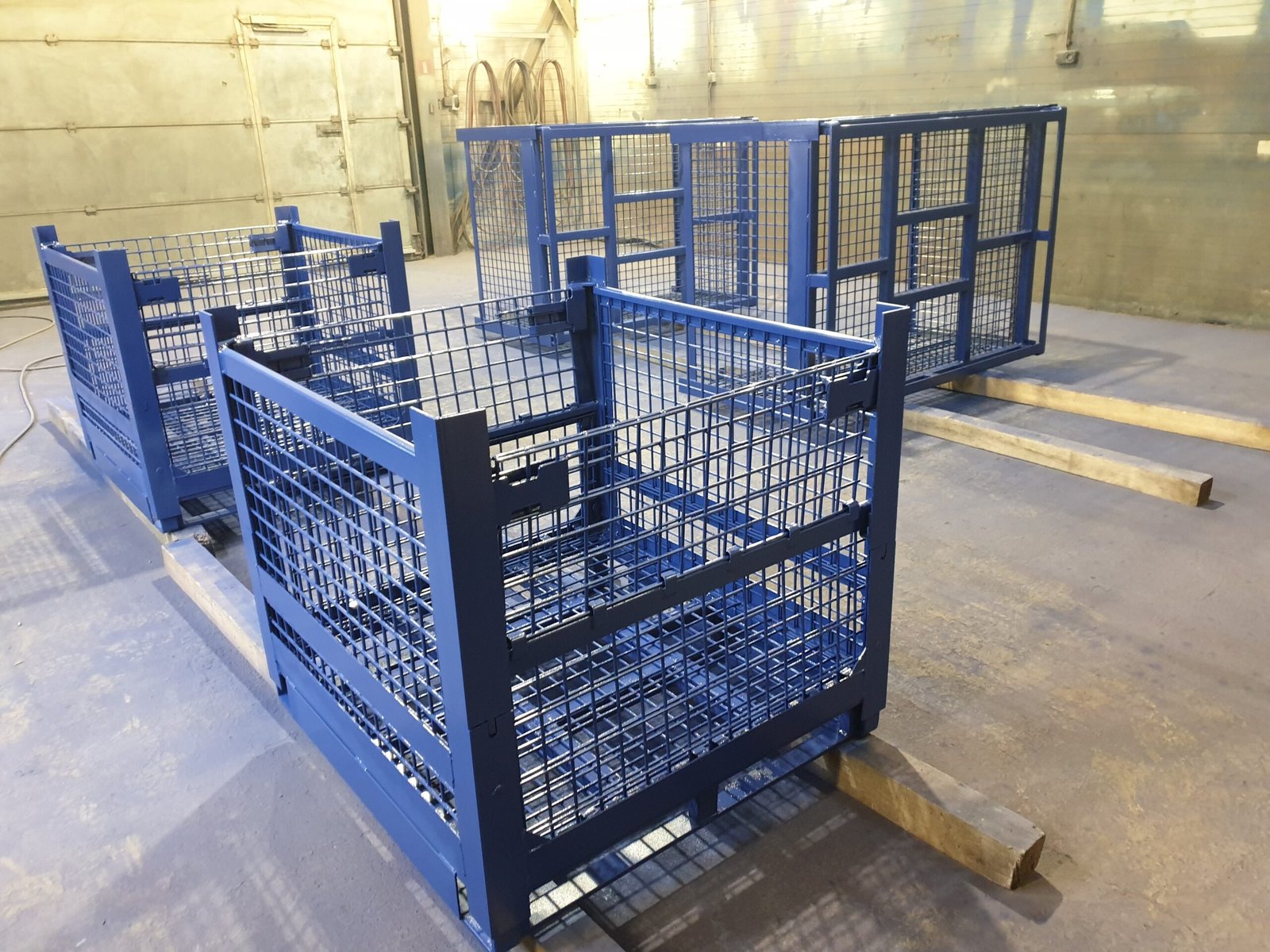
Standard EPAL-style gitterboxes fit many smaller industrial parts. Custom stillages are more common once dimensions, support geometry, or load distribution move beyond the limits of a standard mesh box.
Sweden: automotive, heavy vehicles, engineering and building systems
Sweden is one of the clearest Nordic markets for reusable steel logistics equipment because of its strong automotive, heavy-vehicle, engineering, and industrial systems base. Wherever components circulate between suppliers, assembly sites, and distribution centers, reusable stillages and gitterboxes are a natural fit.
Products commonly handled in Sweden
- stamped parts, brackets, and fabricated automotive components;
- vehicle service parts and powertrain-related subcomponents;
- aluminum profiles and extrusion-based assemblies for industrial systems;
- steel fabrications and structural parts for building-system supply chains;
- machined parts and medium-heavy industrial components.
In Swedish operations, the decision to use stillages is often tied to repeatability. Plants want the same pack pattern every time, the same forklift engagement points, and the same stack logic. That reduces internal handling errors and makes line-side logistics more predictable.
Where the product mix changes or space is tight, collapsible stillages can also make sense because empty returns between suppliers and plants remain an important cost factor.
Finland: forestry machinery, metalworking, profiles, and industrial exports
Finland’s industrial profile is different but still highly compatible with reusable steel packaging. The country has strong traditions in metalworking, machinery, engineered products, and export-oriented manufacturing. Many handled products are robust in weight but still need controlled support and safe movement.
Products commonly handled in Finland
- machinery parts and fabricated assemblies;
- metal components linked to forestry, processing, and industrial equipment;
- profile-based products, frames, and support structures;
- heavy spare parts and service components moving in regional loops;
- export-bound fabricated units needing stronger reusable packaging.
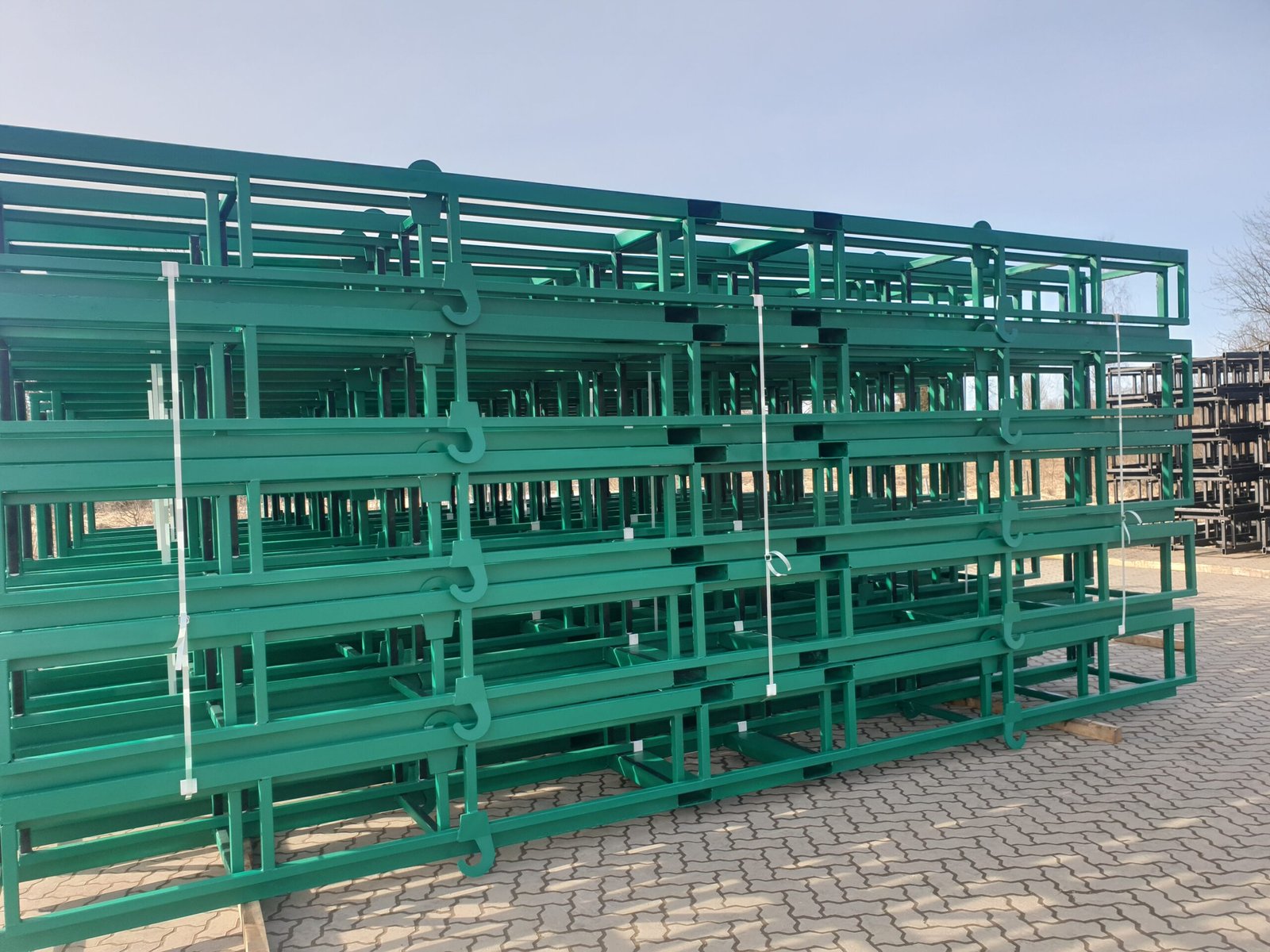
In Finnish operations, stillages often earn their place because they simplify loading and unloading in cold-weather or yard conditions where disposable packaging performs poorly. Reusable steel structures tolerate repeated forklift movement better and are less vulnerable to the moisture and storage issues that can affect wood-based solutions.
For longer or awkward components, support spacing becomes just as important as raw load capacity. That is why custom stillages, profile racks, and transport frames are common where the product does not sit safely in a generic box.
Norway: offshore-related supply, marine industry, machinery, and demanding logistics conditions
Norway’s mix of marine, offshore-related, industrial service, and engineering activity makes durable transport equipment especially useful. Logistics routes can be long, weather exposure is often tougher, and outdoor yard storage is common. In such conditions, packaging that can be reused, stacked, and handled reliably by forklift or crane has clear value.
Products commonly handled in Norway
- marine and offshore support components;
- industrial service parts and maintenance items;
- fabricated steel components and machinery subassemblies;
- profile-based structures and longer fabricated items;
- special parts requiring defined lift points and secure transport geometry.
Norwegian users often prioritize robustness, corrosion protection, and predictable handling in rougher outdoor conditions. That can favor galvanized gitterboxes, painted stillages, and custom transport frames with stronger restraint and drainage logic.
Where products are expensive or irregular, the stillage is also part of the risk-control strategy. The unit is expected to hold the component securely through loading, transport, unloading, and storage without improvised repacking at each stage.
In tougher Nordic logistics environments, a stillage is not just a container. It is the product’s handling interface, transport frame, and storage support in one unit.
Denmark: machinery, food-adjacent equipment, pharma support systems, and export logistics
Denmark combines strong export orientation with industrial sectors that often care about cleaner handling, predictable packaging loops, and controlled product presentation. While not every Danish sector uses the same kind of heavy stillage, reusable steel handling units remain common where products move repeatedly and need better control than pallets alone can provide.
Products commonly handled in Denmark
- machinery components and engineered assemblies;
- equipment frames and fabricated support parts;
- cleaner industrial components where splinter-free reusable packaging matters;
- service parts for wind, industrial systems, and export machinery;
- products needing compact, controlled returnable transport systems.
In Denmark, the decision can be less about brute load and more about consistency, traceability, and reusability. Companies using repeat export loops or internal industrial logistics often prefer steel units because they support defined pack counts, stable stacking, and stronger visual control than disposable packaging.
Why Nordic industries often choose reusable steel units instead of one-way packaging
Across all four countries, the logic is similar. Reusable steel packaging is attractive when the product value, handling frequency, and loop repetition are high enough to justify a more durable system.
- Longer distances make packaging failure more expensive.
- Outdoor storage exposes weak packaging quickly.
- Forklift and crane handling favor defined geometry and stronger support points.
- Closed-loop logistics reward durable returnable packaging.
- Non-standard products often need custom support and restraint.
That does not mean steel is always better. But in the Nordic industrial context, it is often the better answer once the packaging has to behave like reusable handling equipment instead of just one-time shipping material.
Standard gitterboxes vs custom stillages in Scandinavia
Standard gitterboxes are commonly used for smaller metal parts, repeatable component families, and situations where the product fits well into a mesh box footprint. They work especially well when pack patterns are simple and protection demands are moderate.
Custom stillages become more relevant when:
- the product is long, awkward, or unstable;
- support points need to be engineered around the shape;
- the load is high enough that the stillage needs a clearly defined Safe Working Load;
- stacking performance matters;
- the pack pattern must match a specific production or transport routine.
This is why the Nordic market often uses both. Standard gitterboxes solve repeatable small-part movement. Custom stillages solve everything else that does not fit safely into a generic box.
What Scandinavian buyers usually need to define before ordering
- product dimensions, weight, and center of gravity;
- whether handling is by forklift, crane, or both;
- loaded and empty stacking conditions;
- whether the loop is domestic, cross-border, or internal to one site;
- required corrosion protection for yard or outdoor use;
- whether the unit should be fixed, collapsible, stackable, nestable, or all of these.
For heavier or stackable units, the steel structure itself should have a clear Safe Working Load. That is where GorillaBasket’s SWL and testing guides connect directly to the packaging decision.
Related reading: Safe Working Load, SWL Testing for Custom Steel Fabrications, and Steel Pallets vs Wooden Pallets.
What changes between countries and what stays the same
The country mix matters, but not because each Nordic market uses completely different packaging logic. The difference is usually in product shape, transport distance, export pattern, and how exposed the logistics loop is to weather or yard storage. Sweden may show more demand linked to vehicles, industrial systems, and engineered assemblies. Finland often leans more toward machinery, fabricated components, and export-oriented heavy industry. Norway frequently emphasizes durability in harsher outdoor logistics conditions. Denmark often combines cleaner export routines with repeatable machinery and industrial equipment flows.
What stays the same is the reason reusable steel units remain attractive: products move repeatedly, return loops exist, forklift handling is constant, and the cost of packaging failure is high. That is why the same fundamental handling logic appears across all four countries even though the visible product mix changes from one sector to another. Gitterboxes and stillages stay relevant because they solve a Nordic industrial problem that is regional rather than country-specific: durable repeat handling over time.
Frequently asked questions about gitterboxes and stillages in Scandinavia
What products commonly use gitterboxes in Scandinavia?
What products usually need custom stillages instead?
Why are reusable steel units common in Nordic supply chains?
Do the product needs differ by country?
Are collapsible stillages common in Scandinavia?
Conclusion
Gitterboxes and stillages are widely used in Scandinavia because Nordic industry handles a lot of products that are too valuable, too heavy, too awkward, or too repetitive for disposable packaging to remain the best long-term choice. The exact product mix changes from Finland to Sweden, Norway, and Denmark, but the handling logic stays consistent.
Where product protection, repeatability, return logistics, and operational durability matter, reusable steel units remain one of the most practical answers in the region.
Need a stillage or gitterbox for Nordic industrial logistics?
Send the product dimensions, handling method, and return-loop conditions. GorillaBasket can evaluate whether a standard gitterbox, a collapsible unit, or a custom stillage is the better fit.