Why Scandinavia is one of the strongest markets for reusable steel gitterboxes
Most regions use gitterboxes. Scandinavia uses them at a higher rate and with more engineering behind them than most. The reason is not cultural preference. It is a combination of industrial conditions that consistently makes reusable steel the practical choice over disposable alternatives.
Products move over long distances between production sites, warehouses, and ports. Return logistics are often built into the supply chain design from the start. Outdoor storage is common — winter temperatures, moisture, and freeze-thaw cycles test packaging quickly. And a large share of handled goods are heavy, irregular, or valuable enough that packaging failure has a real cost.
Against that background, a steel gitterbox or custom stillage earns its place not as a premium option but as the lowest-risk, lowest-friction solution for the actual operating conditions. Disposable packaging fails too quickly. Generic pallets cannot support the geometry. Only a reusable steel unit with defined handling geometry works reliably across the full cycle — loaded outbound, handled at multiple points, stored outdoors, and returned empty for the next cycle.
The emphasis shifts by country: Sweden leans toward automotive and engineering supply chains; Finland toward machinery, forestry equipment, and export fabrication; Norway toward offshore supply and demanding outdoor logistics; Denmark toward systematic export loops and clean returnable packaging. But the underlying reason reusable steel wins is consistent across all four.
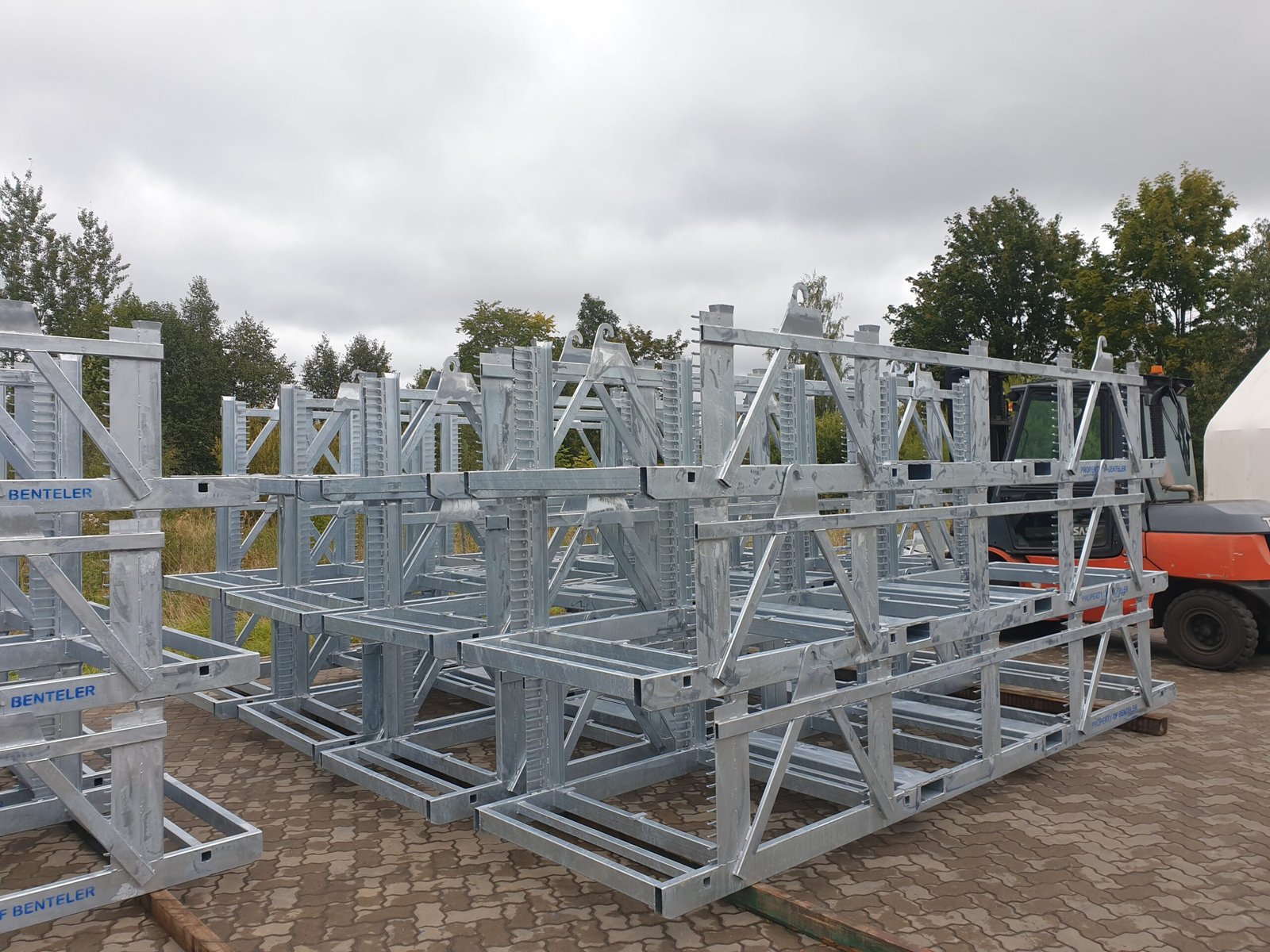
7 product types that commonly use gitterboxes and stillages in Scandinavia
Products end up in gitterboxes and stillages for one or more consistent reasons: they are heavy, they are surface-sensitive, they need a repeatable pack pattern for line-side delivery, their geometry does not work on a flat pallet, or they move through enough handling cycles to make reusable steel more economical than any alternative.
Across Finland, Sweden, Norway, and Denmark, the following seven product families account for the majority of steel gitterbox and stillage demand.
1. Machined metal parts and castings
Machined components represent one of the clearest cases for reusable steel packaging. These parts are expensive to produce, sensitive to surface contact, and often move repeatedly between production stages, assembly lines, and storage. A single scratch or impact on a machined surface can cause a rejection or rework event that costs far more than the entire packaging budget for that batch.
Steel gitterboxes provide consistent support geometry that keeps machined parts separated and stable in transit. The pack pattern is repeatable — operators load the same way every time, which reduces handling errors and makes line-side delivery predictable. In Sweden and Finland, where machined components move through long supply chains serving engineering and equipment manufacturers, this predictability is built into the logistics design.
2. Fabricated steel components and welded assemblies
Weldments, brackets, frames, and structural fabrications are common across all four Nordic markets. They tend to have irregular geometry — the kind that makes standard flat pallets inadequate and improvised timber packing unreliable. A fabricated assembly that shifts during transport, contacts another part, or arrives with distorted geometry creates rework costs and supply chain delays.
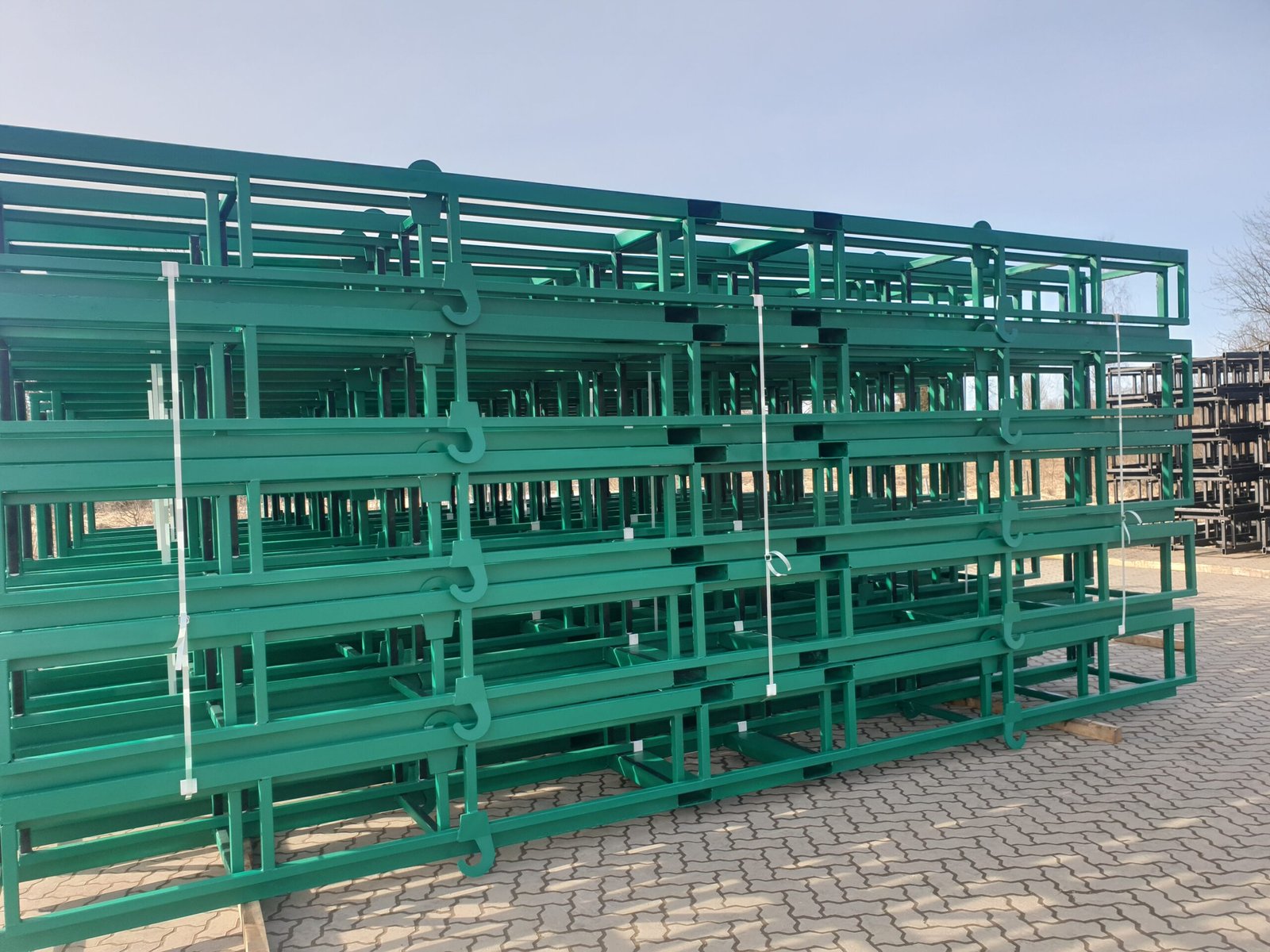
Custom stillages are the typical solution for this product family. The stillage is designed around the specific assembly geometry — defined contact points, side restraint where needed, forklift access built into the frame design. For fabricators supplying OEM customers on regular schedules, the stillage becomes part of the contract: the customer specifies the pack pattern, the stillage enforces it.
3. Aluminum profiles, frames, and long structural parts
Aluminum profiles create handling challenges that standard packaging cannot solve. Their length — often several metres — increases the forklift load center, creates deflection risk if unsupported at enough points, and makes surface damage likely if the bundle contacts hard edges or rolls against itself. Finished surfaces are particularly vulnerable.
Long-load racks and custom stillages with defined support spacing are standard across all four Nordic countries for this product family. The rack keeps the bundle supported along its length, prevents rolling, and allows safe forklift engagement without improvised timber or strap arrangements. For companies supplying aluminum profiles or extrusion-based assemblies across Scandinavia, a purpose-built long-load rack often becomes a fixed part of the delivery system. For more detail on handling this product safely, see How to Safely Move Aluminum Profiles.
4. Automotive and off-highway subcomponents
Sweden is one of Europe’s significant automotive manufacturing centres, and Finland has a strong base in heavy equipment production. Both generate substantial demand for gitterboxes and stillages in the supply chains feeding those industries.
Automotive supply logistics run on tight cycle times with defined pack patterns. A stamped part, bracket, or powertrain subcomponent has a specific way it needs to be loaded, a specific number of parts per unit, and a specific orientation for line-side delivery. The gitterbox or stillage enforces all of that. It is not just a container — it is a quality control tool that ensures the part arrives at the assembly line in the condition and orientation the assembly process requires.
5. Industrial service parts and aftermarket components
Service parts and aftermarket components move differently from production parts. They are often sent individually or in small batches to multiple destinations — repair workshops, service centres, or remote sites. The packaging needs to protect the part through multiple handling events, sometimes over long distances, without the benefit of the controlled logistics loop that production supply chains provide.
Steel gitterboxes are common for this product family because they protect parts that would be damaged by the kind of casual handling corrugated packaging receives in mixed logistics environments. They also make stock management easier — a gitterbox full of a specific part type is easier to count, locate, and track than parts stacked on a wooden pallet under stretch film.
Across all four Nordic countries, companies running regional service parts networks use gitterboxes as a standard format because they survive the handling conditions that their products pass through — outdoor loading docks, multi-modal transport, and storage in environments that are not climate-controlled.
6. Forestry and machinery components — Finland and Sweden
Finland has one of the world’s most developed forestry industries, and with it a substantial base of companies manufacturing, maintaining, and supplying forestry machinery. These machines are large, expensive, and operated in demanding outdoor conditions. The components that keep them running — hydraulic parts, drive components, structural elements, wear parts — are correspondingly heavy and value-dense.
Custom stillages are the standard solution for forestry machinery components because the products are irregular in shape, heavy enough that load capacity matters, and often transported over long distances to remote sites where improvised packaging causes problems. The same applies to Swedish heavy equipment manufacturing, where similar handling logic applies to a different set of end-product industries.
In Finnish operations specifically, the outdoor yard environment is a deciding factor. Packaging that degrades in cold, wet conditions creates real operational problems when units sit outside between production cycles. Steel does not degrade in these conditions. Wood does — quickly and visibly.
7. Marine and offshore supply parts — Norway
Norway’s marine and offshore industries create a specific and demanding version of the industrial handling problem. Components are often expensive and irregular. Logistics routes can be long and multi-modal — road, sea, and sometimes air. Storage at intermediate points is frequently outdoors or in unheated facilities. And the end destination may be a vessel at sea or an offshore installation where the supply window is narrow and a damaged or incorrectly packed part cannot easily be replaced.
In this context, the stillage is not just a cost-efficiency tool — it is a risk management tool. A galvanized gitterbox or custom stillage with defined crane lifting points, drainage geometry to prevent water pooling, and positive restraint geometry does not just carry the component. It eliminates a category of risk from the supply chain.
Norwegian buyers in marine and offshore supply chains tend to specify more rigorously than buyers in other sectors. They ask about corrosion protection, safe working load, lift points, and how the unit behaves in wet outdoor storage. Those are the right questions — and they typically lead to a custom or semi-custom solution rather than a standard gitterbox.
Standard gitterboxes vs custom stillages: which fits your product?
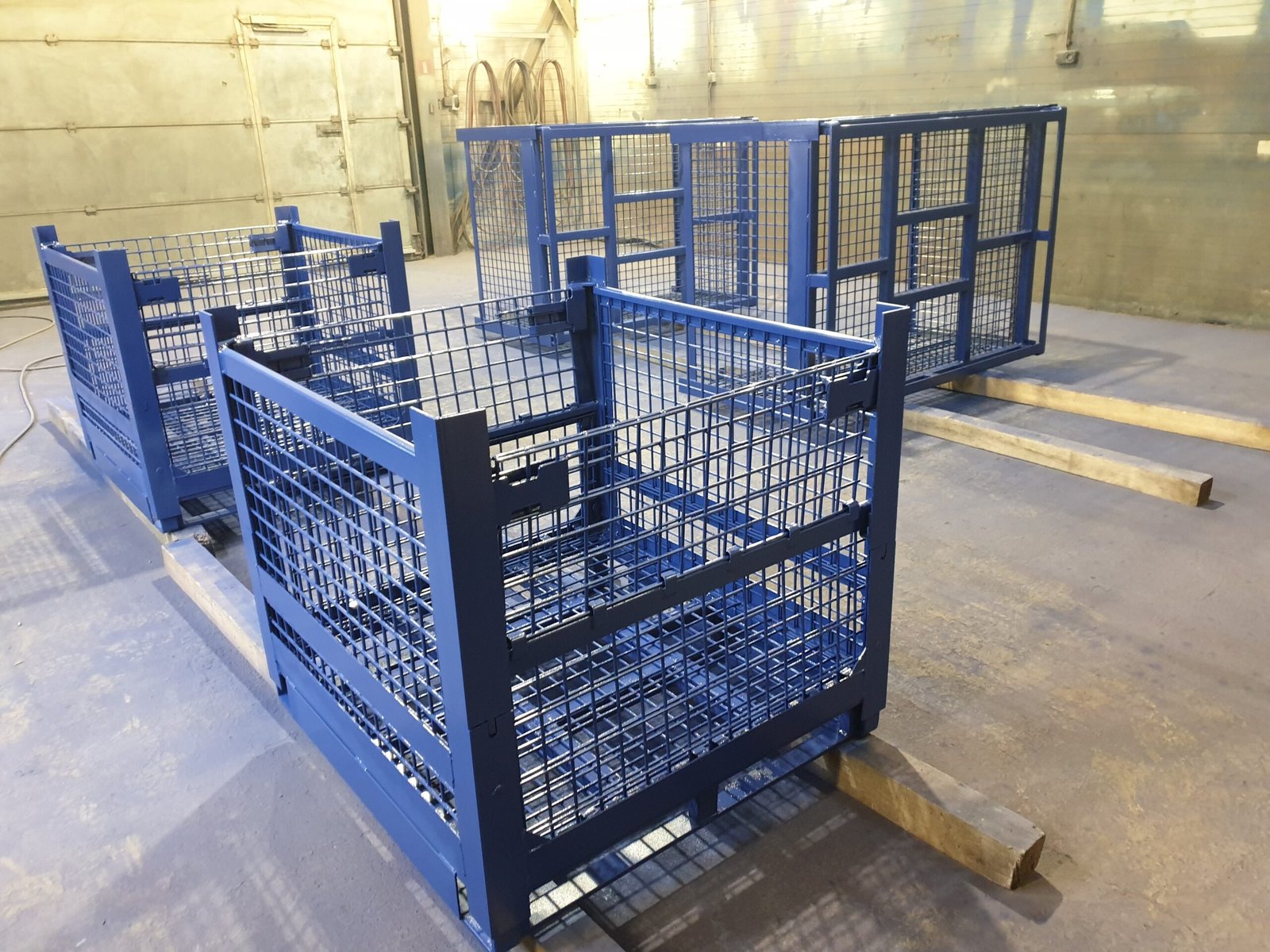
EPAL-format gitterboxes and standard mesh containers work well for a large proportion of Scandinavian industrial parts. If the product is smaller than the box footprint, does not need defined positioning or support geometry, and can be loaded and unloaded without risk of surface damage from contact with the mesh walls, a standard gitterbox is usually the right and most cost-effective choice.
Custom stillages become necessary when:
- the product is too long, too large, or too irregularly shaped for a standard box;
- surface contact with mesh or steel walls would damage the product;
- defined support points are needed to prevent deflection or distortion;
- the load is heavy enough that the structure needs a clearly defined Safe Working Load — see Safe Working Load (SWL): Meaning, Formula and Safety Factors;
- stacking performance matters and needs to be engineered rather than assumed;
- the pack pattern must match a specific production or logistics routine precisely.
In practice, Nordic operations typically use both. Standard gitterboxes handle smaller, repeatable part families. Custom stillages handle everything that does not fit safely or efficiently in a standard box — which, in heavy industrial supply chains, is a significant proportion of the product range.
What Scandinavian buyers typically define before ordering
Whether the requirement is a standard gitterbox or a custom stillage, the starting point is the same: a clear description of the product, the handling method, and the logistics loop the unit will run in.
- Product dimensions, weight, and centre of gravity;
- whether handling is by forklift, crane, or both — and the specific equipment on site;
- loaded and empty stacking conditions;
- whether the return loop is domestic, cross-border, or internal to one site;
- required corrosion protection — particularly important for outdoor or coastal storage;
- whether the unit should be fixed, collapsible, stackable, nestable, or a combination of these.
For heavier units or any application involving stacking or crane lifting, the structure needs a clearly defined Safe Working Load. That is where fabrication engineering connects directly to the packaging decision. For a full explanation of how load ratings work for steel fabrications, see Safe Working Load Testing for Custom Steel Fabrications.
Frequently asked questions about gitterboxes and stillages in Scandinavia
What products commonly use gitterboxes in Scandinavia?
What products need custom stillages instead of standard gitterboxes?
Why are reusable steel gitterboxes so common in Nordic supply chains?
Do gitterbox needs differ between the four Nordic countries?
Are collapsible gitterboxes common in Scandinavia?
Conclusion
Gitterboxes and stillages are standard equipment in Scandinavian industrial supply chains because the region’s handling conditions demand them. Long distances, outdoor storage, closed-loop logistics, and products that are too heavy, too irregular, or too valuable for disposable packaging — these conditions exist across all four markets and they consistently point toward the same answer.
The exact product mix shifts from Finland to Sweden to Norway to Denmark. The underlying logic does not. Where product protection, repeatable pack patterns, return logistics efficiency, and structural durability all matter, reusable steel gitterboxes and custom stillages are the solution that Nordic industry settled on — not as a premium option, but as the one that actually works across the full operating cycle.
Need a gitterbox or stillage for Nordic industrial logistics?
Share the product dimensions, weight, handling method, and return-loop conditions. GorillaBasket can evaluate whether a standard gitterbox, a collapsible unit, or a custom stillage is the right fit — and provide pricing based on the actual requirement.