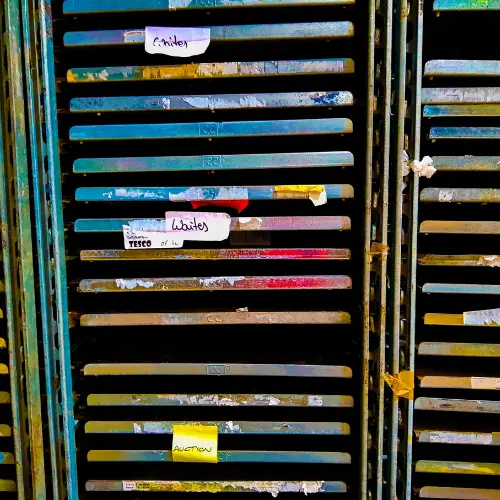
The real reason wooden pallets dominate — and why it is not a good one
Wood is the default because it was always the default. Buyers inherit the decision from whoever set up the warehouse before them. Nobody questions it because the unit cost looks fine on a purchase order.
The problem is that the purchase order only captures the buy price, not the operating cost. It does not show how many wooden pallets were replaced last year, how many product damage events were linked to a failed or degraded platform, or how much time was spent managing broken units. When those numbers get added up, the calculation often changes significantly.
Steel pallets and steel stillages cost more to buy. That is true and not worth arguing against. What they offer in return is a platform that performs the same way at cycle 500 as it did at cycle one — and that stays in service for a decade rather than needing repeated replacement.

Steel pallets vs wooden pallets: head-to-head across 7 critical differences
The table below covers every dimension that matters in industrial pallet selection. Not catalogue specs — real operational performance differences that affect safety, cost, and reliability over time.
| Category | Steel pallets and stillages | Wooden pallets | Advantage |
|---|---|---|---|
| 1. Load capacity | Engineered to a defined Safe Working Load. Stable across thousands of handling cycles regardless of age or moisture. | Standard ratings assume good condition. Degrades with moisture, impact, and age. Actual capacity reduces over time. | Steel – rated load stability Load capacity stays consistent across cycles despite moisture, impact, and age. |
| 2. Lifespan | Commonly 10–15 years with basic maintenance in industrial environments. | Often 3–5 years in comparable heavy-duty use. Sometimes less in wet or rough conditions. | Steel – longer service life Steel platforms typically last 10-15 years in heavy use with basic maintenance. |
| 3. Total cost over time | Higher upfront. Lower per cycle in heavy-duty applications once replacement and damage costs are counted. | Lower upfront. Higher total cost when replacement frequency, repair burden, and product damage are included. | Steel – lower cost per cycle Higher upfront cost is offset by fewer replacements and less damage over time. |
| 4. Hygiene and cleanliness | Non-porous, no splinter risk, cleanable surface. Suitable for sectors where contamination control matters. | Absorbs moisture. Can harbour mould, bacteria, and pests. Splinters create contamination and debris risk. | Steel – cleanable, non-porous Steel can be washed and inspected without splinters, moisture absorption, or mould risk. |
| 5. Customisation | Fully custom dimensions, lifting points, fork pockets, stacking features, side restraint, and surface finish. | Mostly standard sizes. Limited adaptation. Cannot be engineered around a specific product geometry. | Steel – custom-fit geometry Dimensions, restraint, fork pockets, and stacking features can match the actual product. |
| 6. Stacking performance | Engineered stacking geometry. Defined stacking load. Predictable behaviour under load at height. | Stacking behaviour depends on condition. Less reliable under repeated heavy stacking. Fails unpredictably as it ages. | Steel – predictable stacking Engineered stacking loads and geometry perform reliably at height. |
| 7. Export compliance (ISPM 15) | Not subject to ISPM 15. No treatment, marking, or documentation required for cross-border shipments. | Subject to ISPM 15 requirements. Treatment and marking required. Non-compliant loads can be rejected at border controls. | Steel – no ISPM 15 No treatment, marking, or export documentation required for cross-border shipments. |
Wood wins on one dimension: purchase price. On every other dimension that affects industrial performance, steel pallets and stillages are the stronger platform.
Load capacity: why steel’s advantage compounds over time
A new wooden pallet rated for 1,000 kg may perform to that rating. The same pallet after two years of forklift handling in a humid warehouse is a different object — and nobody measured how much it degraded. Boards swell, joints loosen, repairs vary in quality, and the actual load capacity at any given moment is unknown.
Steel pallets and stillages are engineered to a defined Safe Working Load. That rating is based on real structural calculations, not a catalogue assumption. It stays accurate because steel does not absorb moisture, does not splinter, and does not degrade the same way wood does under repeated industrial handling.
For heavy products, high-value components, or any application where stacking is involved, that consistency is not a minor advantage. It is the difference between a platform you can trust and one you are guessing about.
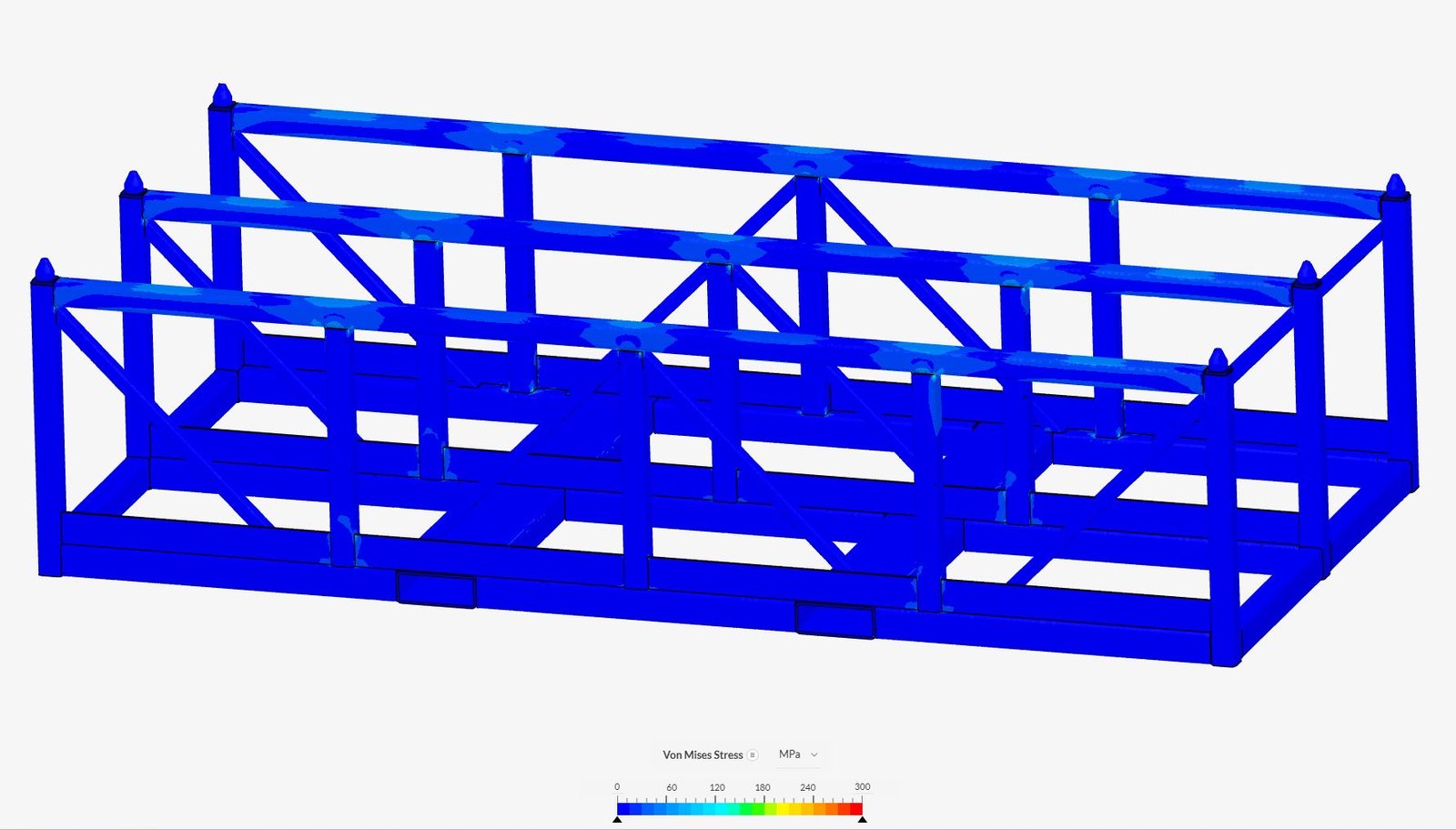
Total cost of ownership: the calculation most buyers skip
Steel pallets typically cost 3 to 4 times more than wooden pallets to buy. That number is real and it should not be ignored. But it is only half the picture, and it is the less important half for anyone running a repeat industrial operation.
The more relevant comparison is cost per handling cycle over the full service life of the platform. A steel pallet that lasts 12 years and costs four times as much as wood that lasts three years is already cost-neutral on lifespan alone — before accounting for replacement labour, disposal, product damage events, or downtime caused by a failed platform.
Here is a straightforward way to make the case internally: count how many wooden pallets your operation replaced last year. Multiply that by the unit cost. Add up any product damage or handling incidents linked to a degraded pallet. That is what wood is actually costing — it just does not appear as a single line item on a purchase order.
| Cost factor | Wood | Steel |
|---|---|---|
| Initial purchase | Lower | Higher (typically 3–4×) |
| Service life | 3–5 years in heavy use | 10–15 years with basic maintenance |
| Replacement frequency | High — multiple replacements per steel unit lifespan | Low — one unit over the full period |
| Repair and maintenance | Frequent in demanding operations | Minimal — inspect and clean |
| Product damage risk | Increases as platform degrades | Consistent — does not degrade in the same way |
| Cost per cycle (long term) | Higher once all factors counted | Lower in most heavy industrial applications |
ISPM 15 and why it matters for buyers shipping internationally
ISPM 15 — the International Standards for Phytosanitary Measures — requires that solid wood packaging material used in international trade be heat-treated or fumigated and carry official marking confirming compliance. The standard exists to prevent the spread of invasive pests and diseases through wood packaging.
Non-compliant wood packaging can be rejected at border controls, held for treatment, or destroyed. For a buyer with time-sensitive cross-border industrial logistics, that is not a theoretical risk — it is a real operational and cost exposure.
Steel pallets and stillages are not wood. They are not subject to ISPM 15. There is no treatment requirement, no marking requirement, and no documentation burden. For buyers running European or international supply chains, that removes an entire compliance layer from every shipment.
For some operations, this is a secondary consideration. For buyers who ship regularly between countries — particularly into markets with strict border enforcement — it can be a decisive one.
Hygiene, cleanliness, and sectors where contamination matters
Wooden pallets absorb moisture. Over time, that creates conditions where mould, bacteria, and pests can establish themselves in the wood. Splinters create debris. Boards become uneven. In food-adjacent manufacturing, pharmaceutical environments, or any sector with cleanliness requirements, these are not acceptable risks.
Steel pallets and stillages have smooth, non-porous surfaces that can be wiped down, washed, or inspected visually without ambiguity. There is no absorption, no splintering, and no hidden contamination risk inside the material. The surface you can see is the surface you are working with.
Even in general industrial environments where hygiene is not the primary concern, the absence of splinters and debris makes steel platforms easier to manage around sensitive products — painted components, machined surfaces, finished goods, or anything where surface contact matters.
Customisation: why steel can be built around the actual product
A standard wooden pallet is a flat rectangle. It works for anything that sits stably on a flat surface and does not need defined positioning, side restraint, or specific forklift engagement geometry.
Most demanding industrial products need more than that.
Custom steel pallets and steel stillages can be built around the exact geometry of the product being handled. That means defined contact points that protect the product’s surface, side walls or restraint features that prevent shifting during transport, fork pockets positioned for the actual forklift and aisle geometry on site, and stacking capability engineered to a defined load rather than estimated.
- exact footprint matched to the product or transport unit;
- fork pocket spacing matched to the handling equipment in use;
- crane lifting points where overhead handling is needed;
- stacking features engineered for defined storage loads;
- surface finish — painted, powder-coated, or hot-dip galvanized — selected for the operating environment.
For products that are machined, painted, surface-sensitive, or dimensionally awkward, a custom steel platform is not a luxury. It is the only way to handle the product reliably without improvising around the limitations of a generic flat pallet.
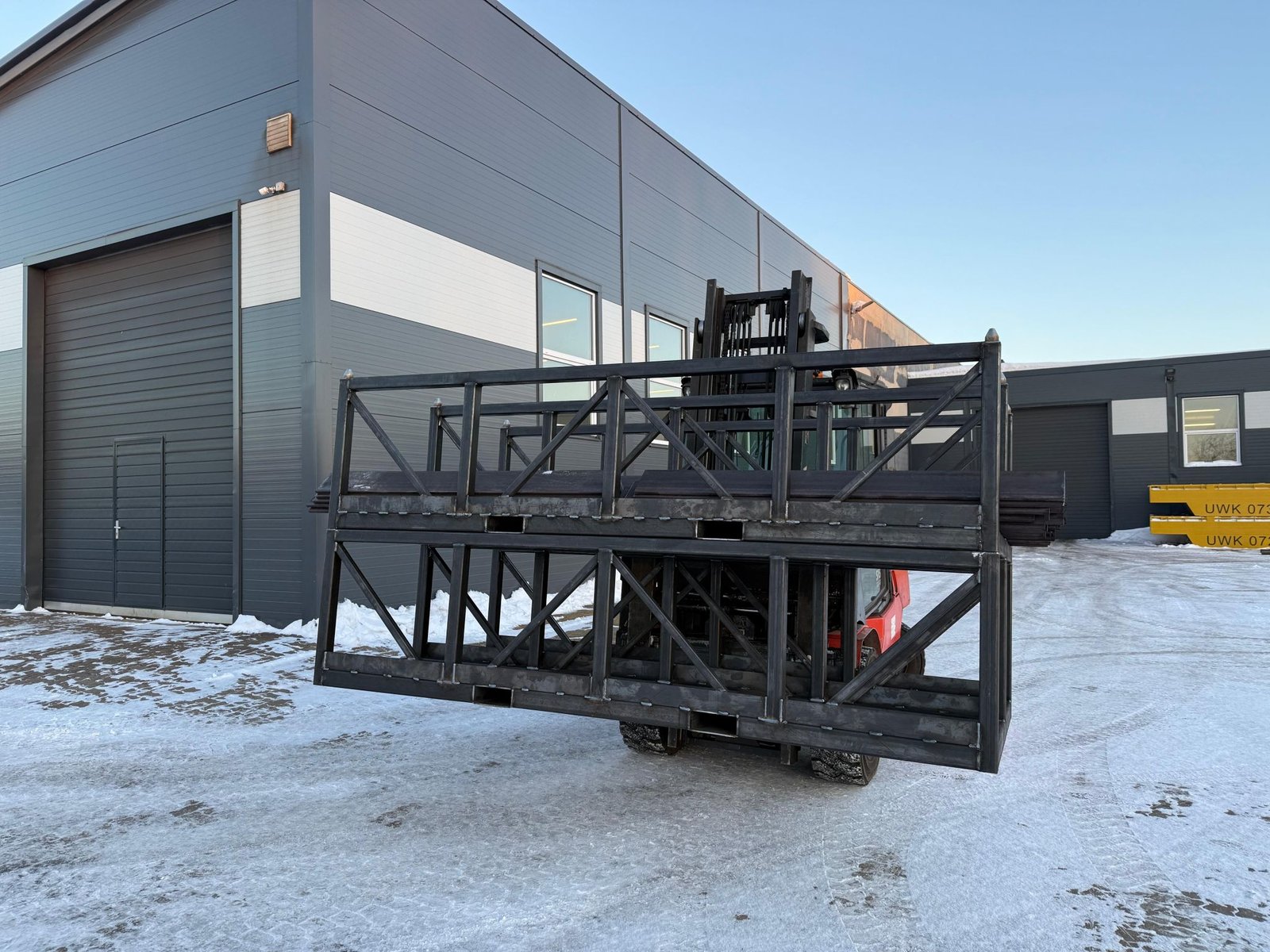
When wood still makes sense — and when it clearly does not
Wood is not always the wrong answer. There are applications where it remains the practical choice and where the economics of steel do not apply.
Wood still makes sense when:
- the shipment is one-way and the pallet will not be returned;
- loads are light and handling is infrequent;
- the product is low-value and damage risk is acceptable;
- the operation has a short timeline where long-term replacement cost is irrelevant;
- hygiene, custom fit, and stacking precision are not requirements.
Steel becomes the clearly stronger choice when:
- the pallet is reused repeatedly in a return loop;
- loads are heavy enough that structural confidence matters;
- the product is valuable, surface-sensitive, or easy to damage;
- stacking is required and stack stability must be reliable;
- the operation runs cross-border logistics where ISPM 15 compliance is a factor;
- the environment is wet, outdoor, or operationally rough;
- the product needs a custom geometry that a flat pallet cannot provide.
In most serious industrial operations, the conditions in that second list apply. That is why steel pallets and stillages are standard in automotive manufacturing, heavy machinery production, metal fabrication, and industrial logistics — not because they are expensive, but because they are the right tool for what those operations actually demand.
What to define before ordering a custom steel pallet or stillage
The faster you can answer these questions, the faster an engineer can propose a solution and provide accurate pricing.
- Maximum product weight and position of the centre of gravity;
- whether handling is by forklift, crane, or both;
- stacking height and maximum stacking load in storage or transport;
- indoor, outdoor, or corrosive operating environment;
- required surface finish — paint, powder coat, or hot-dip galvanizing;
- whether engineering calculations or load testing documentation is required.
For a full explanation of how load capacity is defined and verified for custom steel fabrications, see Safe Working Load Testing for Custom Steel Fabrications.
Frequently asked questions about steel pallets vs wooden pallets
Are steel pallets worth the higher upfront cost?
How long do steel pallets last compared with wooden pallets?
What is ISPM 15 and does it affect pallet choice?
Can a steel pallet be built for a non-standard product?
When does wood still make sense over steel?
Conclusion
Steel pallets and wooden pallets are not equally matched options that come down to preference. They are different tools for different jobs. Wood works fine for light, infrequent, or one-way applications. Steel is the right platform once load, repetition, value, safety, or compliance make the cost of wood’s weaknesses unacceptable.
The buyers who switch to steel do not do it because it looks better in a catalogue. They do it because they added up what wood was actually costing and the number surprised them.
Need a steel pallet or stillage built for the actual job?
Share the product weight, dimensions, handling method, stacking requirement, and operating environment. GorillaBasket can propose a steel pallet or stillage built around the real load case — not adapted from a generic standard.
If you already have drawings or CAD files, sending them speeds up evaluation significantly.