Why wood keeps winning procurement decisions it should not win
Walk into almost any industrial warehouse and you will find wooden pallets. Not because they are the best platform available. Because they are familiar, they are already in the budget, and switching requires someone to make a decision that nobody asked them to make.
That inertia is the real reason wood dominates. It is not performance. It is not economics. It is the fact that the cost of wood is visible on a purchase order and the cost of wood’s failures is spread across damage reports, replacement invoices, maintenance logs, and downtime records that nobody ever adds together.
Once someone adds them together, the decision usually changes.

The predictability problem: why wood gets worse without anyone noticing
This is the issue that drives more switches to steel than any other, and it almost never appears in a formal analysis because it is hard to measure.
A new wooden pallet rated for 1,000 kg may well perform to that rating. The same pallet after eighteen months of forklift handling in a warehouse that sees moisture, temperature variation, and the occasional rough impact is a different object. Boards have swollen and dried. Joints have loosened. Repairs have been made with varying quality. The actual load capacity at any given moment is somewhere below the original rating — but nobody knows how far below.
That is not a theoretical risk. In industrial operations, pallets are used interchangeably. A weakened pallet enters the stack without anyone knowing it is weaker. It goes under a crane lift. It supports a stack of heavy components overnight. The failure, if it comes, looks sudden. It was not sudden. It was incremental, invisible, and entirely predictable — just not to the people using the equipment.
Steel pallets and stillages do not work this way. The rated load is based on engineering calculations. It stays accurate because steel does not absorb moisture, does not splinter, and does not degrade under repeated industrial handling the way wood does. The pallet that performed at cycle one performs the same way at cycle 500.
That is what buyers mean when they say steel is more predictable. They do not mean it looks more engineered. They mean they can trust what is written on the side of it — and with wood, over time, they cannot.
What steel pallets actually do differently
The case for steel is not that it is strong. Most pallets are strong enough at the start. The case is that steel keeps performing when wood stops — and that it can be built around the actual product rather than forcing the product to adapt to a generic flat platform.
Consistent load capacity across the full service life
A steel pallet engineered to a defined Safe Working Load carries that load reliably for its entire service life. The rating does not drift as the unit ages. Inspections confirm condition, but the structural properties do not quietly change between inspections.
Custom geometry around the real product
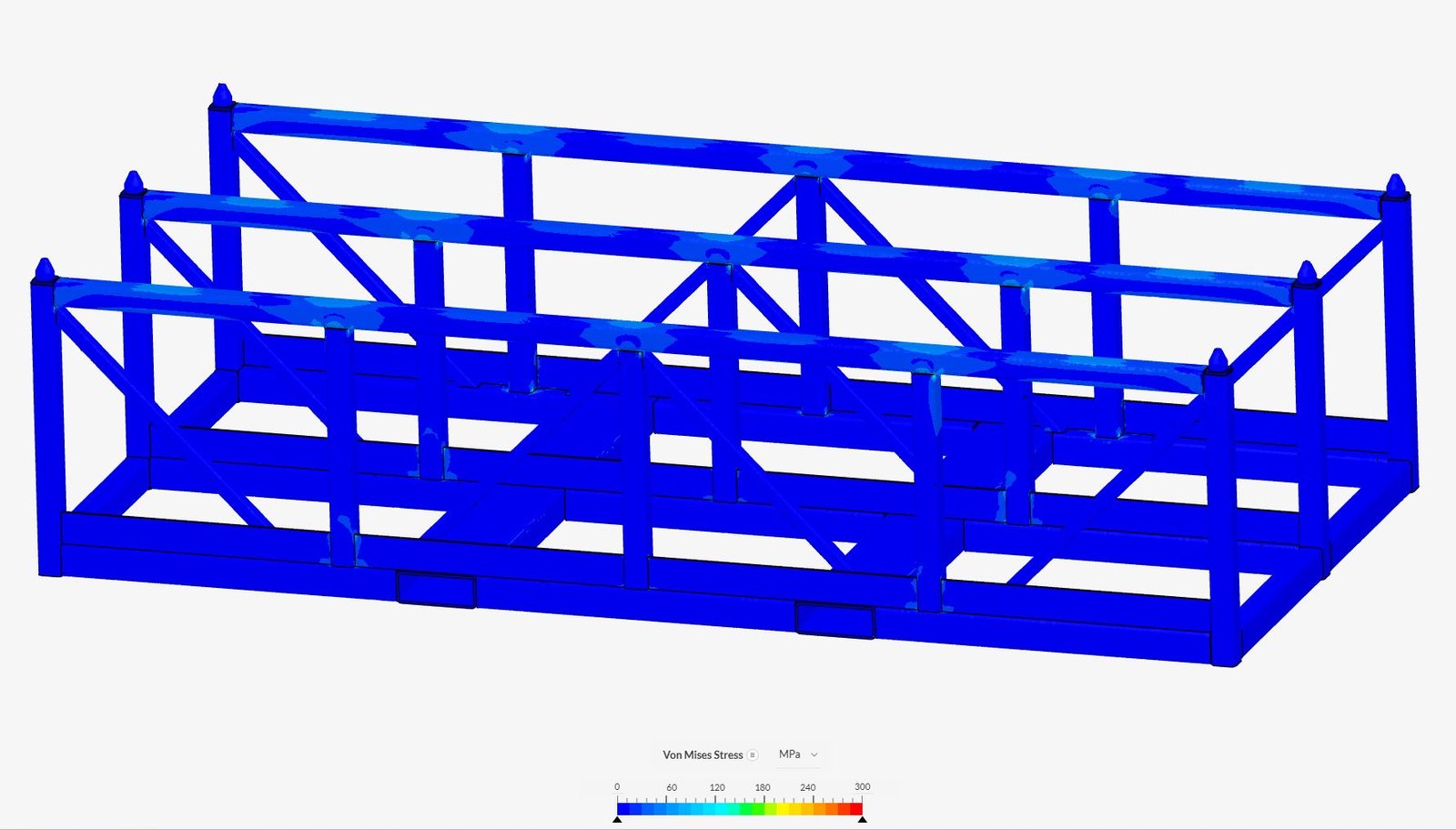
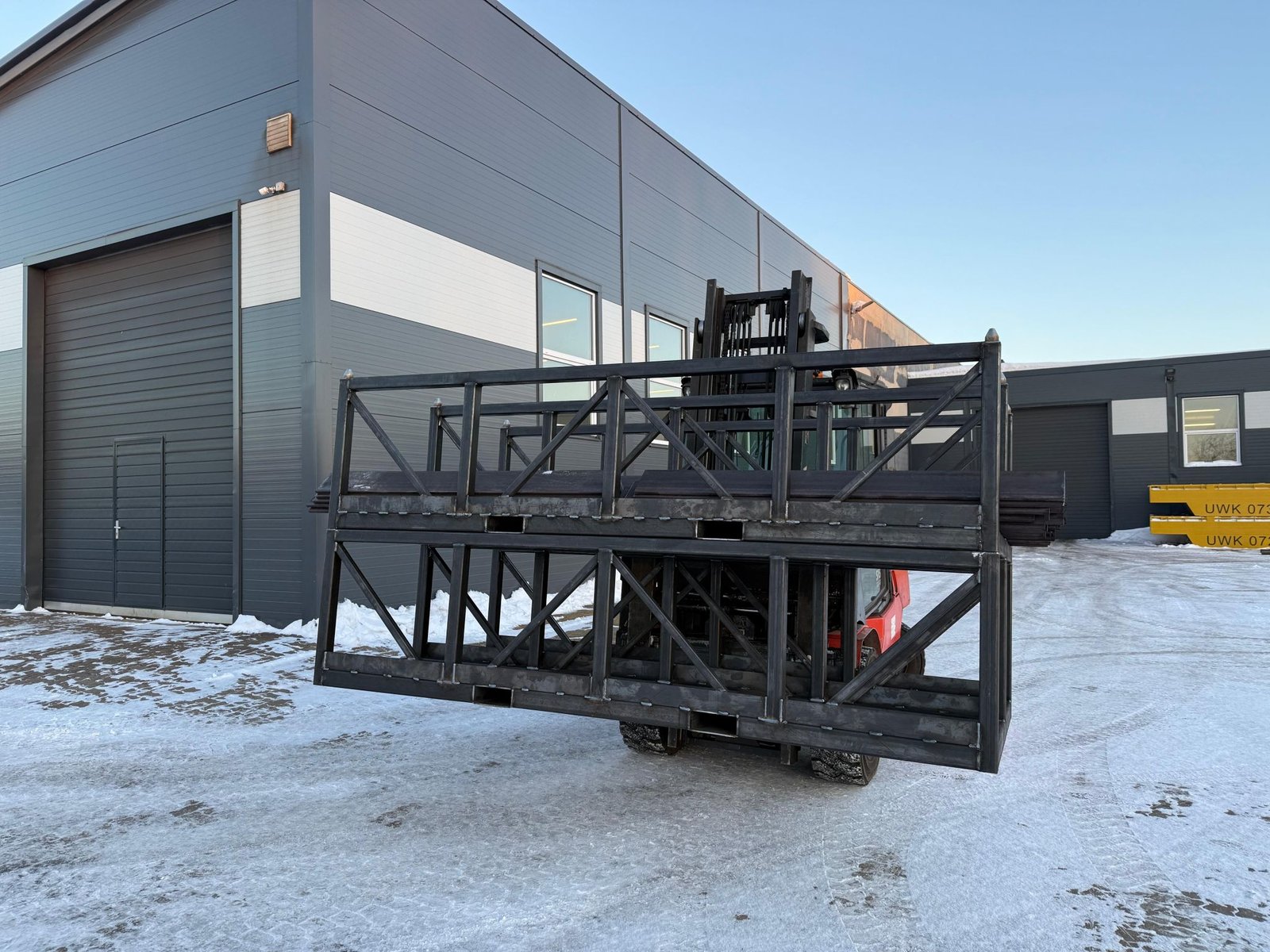
Standard wooden pallets assume a product that sits stably on a flat surface. Most demanding industrial products do not work that way. A custom steel pallet or stillage is built around the actual product — exact footprint, defined contact points that protect the surface, fork pockets positioned for the specific handling equipment on site, and stacking features engineered to a load rather than estimated from a catalogue.
Stacking you can rely on
Stacking wooden pallets under heavy loads is an act of optimism. The stack’s behaviour depends on the condition of every pallet in it, which varies. Steel pallets and stillages with engineered stacking geometry behave predictably because the geometry is fixed and the load path is designed rather than assumed.
Lower total cost over the real service life
Steel typically costs 3 to 4 times more upfront. It typically lasts 3 to 5 times longer in comparable heavy-duty use. Once the full period is considered — including the labour cost of managing replacements, the product damage exposure of a degrading platform, and the operational disruption of a pallet that fails in service — steel is consistently cheaper per cycle in demanding industrial applications.
How to build the internal case for switching to steel
The barrier to switching is almost never technical. Engineers and operations teams usually understand why steel performs better. The barrier is internal approval — procurement that optimises for unit cost, finance that questions upfront spend, and a default assumption that the current system is working well enough.
The way through is to make the cost of the current system visible. Here is how to do it.
Step 1: Count replacements
How many wooden pallets did the operation replace last year? Multiply by the unit cost. This is the baseline replacement spend — the minimum ongoing cost of the current system, before anything else goes wrong.
Step 2: Add damage events
Look at product damage reports from the last twelve months. Identify any where a degraded or failed pallet was a contributing factor. Estimate the direct cost: damaged product, rework, claims, customer complaints. Add it to the replacement spend.
Step 3: Add operational friction
How much time does the operation spend managing broken pallets? Pulling failed units, sourcing emergency replacements, reloading product that was on a damaged platform? Even at a conservative estimate, this number adds up.
Step 4: Project forward
A steel pallet that costs four times as much and lasts five times longer is already a better financial decision over five years — before the damage and friction numbers. Add those in and the case becomes straightforward.
Most buyers who go through this exercise find that the total annual cost of wood is larger than expected, and that the payback period for steel is shorter than it looked when comparing only the purchase price.
Where wood still makes sense — and where it clearly does not
Steel is not the right answer for every application. There are specific situations where wood remains practical and where the economics of a longer-life platform do not apply.
Wood makes sense when:
- the shipment is one-way and the pallet will not be returned;
- loads are light and handling is infrequent;
- the product is low-value and damage risk is acceptable;
- the operational timeline is short enough that long-term replacement cost does not matter.
Steel becomes the clearly right choice when:
- the pallet is reused repeatedly — any closed or semi-closed return loop;
- loads are heavy enough that consistent structural performance matters;
- the product is valuable, surface-sensitive, or machined;
- stacking is required and stack behaviour must be reliable;
- the operating environment is wet, outdoor, or physically demanding;
- the product has a geometry that a flat pallet cannot support properly.
In most serious industrial operations — automotive, heavy machinery, metal fabrication, industrial logistics — the conditions in the second list describe the majority of handling. That is not a coincidence. Those are exactly the environments where the hidden costs of wood become visible and where the switch to steel pays back quickly.
Frequently asked questions about steel pallets instead of wood
Why should I use steel pallets instead of wood?
How do I justify steel pallets to procurement?
Are steel pallets always better than wood?
What is the biggest practical advantage of steel pallets?
Can steel pallets be custom-built for a specific product?
Conclusion
The buyers who switch from wood to steel are not doing it because someone told them steel is better. They are doing it because they looked at what wood was actually costing — the full picture, not just the purchase price — and found the number surprising.
If you have not done that calculation for your operation, it is worth doing. The result often makes the decision straightforward.
For a full head-to-head comparison of steel and wooden pallets across every performance dimension, see Steel Pallets vs Wooden Pallets: 7 Critical Differences. For the load rating and engineering side, see Safe Working Load (SWL): Meaning, Formula and Safety Factors.
Ready to find out what steel would cost for your application?
Share the load weight, product dimensions, handling method, and stacking requirements. GorillaBasket can propose a steel pallet or stillage built around the actual job — and provide a quote that makes the comparison with wood straightforward.
If you already have drawings or CAD files, sending them speeds up the process significantly.